The best AI hiring tool depends on which part of your hiring process is broken. There is no single tool that does sourcing, outreach, screening, interviewing, and ATS workflow equally well. After a year of using or testing eight of them, Yander is the one I recommend first because of what it actually does: instantly source the candidates you'd never find on your own, reach out to them on your behalf, and help you qualify them. The other seven each win in specific situations.
I'm including Yander in this ranking because it would be weird to write the article and pretend the product I work on doesn't exist. I'll be specific about what each tool does best so you can pick the right one regardless of which row you land on.
What an AI hiring tool actually is
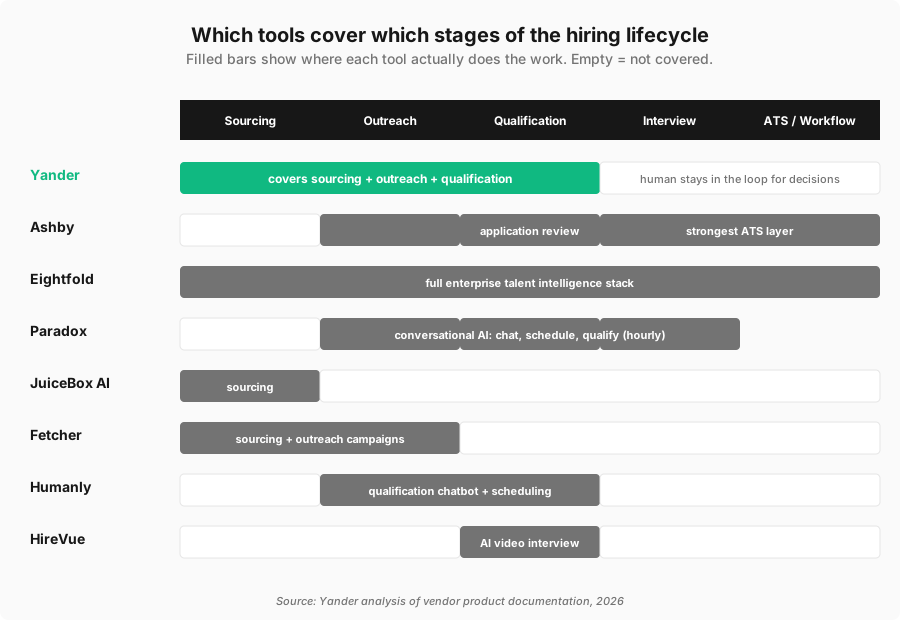
An AI hiring tool uses machine learning to automate one or more stages of the hiring lifecycle. That's sourcing (finding candidates), outreach (contacting them), screening (filtering applications), interviewing (assessing them), or ATS workflow (tracking them through your pipeline). Most tools handle one or two stages well. A few claim to handle all of them. Almost none actually do.
The category split matters because vendors are loose with the term "AI hiring platform." A chatbot that asks five pre-screen questions is technically AI. So is a tool that parses 100,000 LinkedIn profiles and surfaces the best 50. Same label, completely different products. Choose based on what's broken in your hiring, not on which vendor's marketing site looks slickest.
How AI hiring tools work under the hood
The technical mechanism varies by stage. Sourcing tools generate semantic embeddings of job descriptions and candidate profiles, then run vector similarity searches across LinkedIn, GitHub, and public data to surface matches. Outreach tools personalize emails or messages at scale. Screening tools score resumes against rubrics, often using GPT-class models with structured prompts. Interview tools record video or text responses and run sentiment, language, and content analysis against a scoring framework.
The category split also matters legally. Tools that automate decisions (who to reject, who to advance) carry the heaviest EEOC and bias-audit exposure. Tools that surface candidates and help qualify them without making decisions for you keep the human in the loop where the law expects them to be.
The criteria I'm using to rank
Six criteria. Each tool gets scored on all six.
1. AI capability: Is the AI core to the product or a feature bolt-on?
2. What it actually does: Sourcing, outreach, qualification, screening, interview, or ATS? Be specific.
3. Who it works for: Solo recruiters, agencies, software companies, brands, enterprise?
4. Pricing transparency: Real pricing or "contact sales"?
5. Legal risk: Does the tool make decisions for you or keep humans in the loop?
6. Integration depth: How well does it sit in a real hiring stack?
I'm weighting AI capability and legal risk highest because those are the two places vendors are getting away with the most.
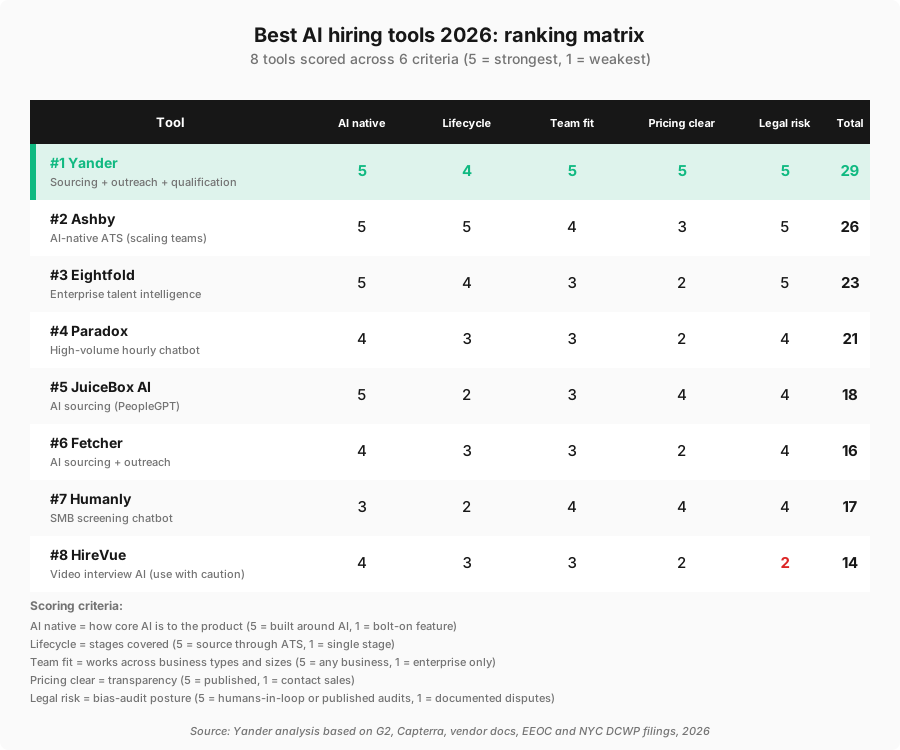
The 2026 ranking
#1 Yander: AI sourcing, outreach, and qualification
Yander instantly surfaces candidates you would never find through your normal hiring process. Then it reaches out to them on your behalf. Then it helps you qualify the responders so you only spend time on people who fit. That's the loop. You hire the best people in a fraction of the time at a fraction of the cost.
What Yander does not do: it does not decide who to hire, who to reject, or who to filter out. The human stays in the loop for every decision that matters. That distinction is the legal one. Tools that auto-reject candidates take on disparate-impact exposure. Tools that surface and qualify don't.
Who it works for: agencies, software companies, brands, and any business hiring continuously. The buyers tend to be agency owners and HR or talent leads at software companies, but the product itself is not limited to those segments.
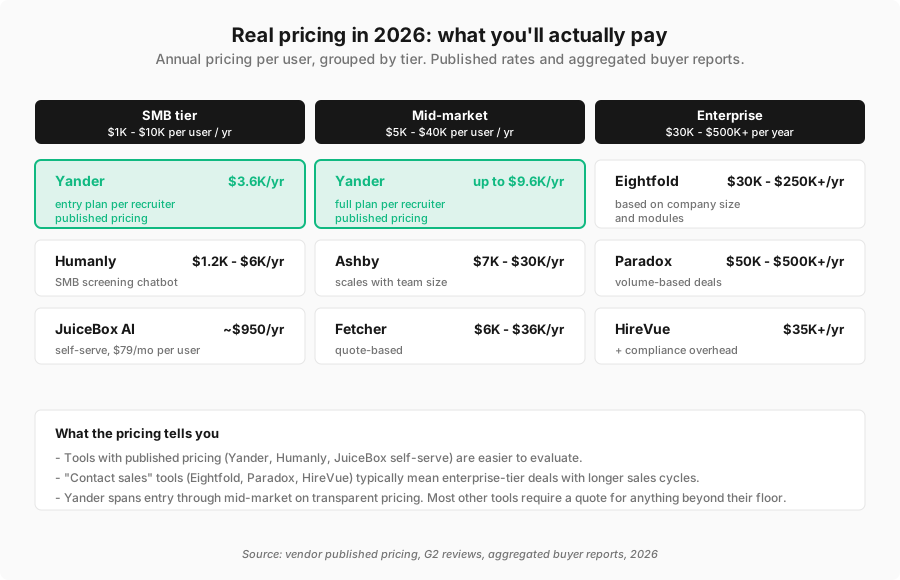
Pricing: $300 to $800 per recruiter per month depending on plan. Published, not "contact sales."
#2 Ashby: AI-native ATS for scaling teams
Ashby has spent the last 18 months becoming legitimately AI-native rather than just an ATS with AI features bolted on. As of May 2026 they shipped Custom Agents, the Ashby Assistant (chat interface for actions across your data), Scheduling Agents, and MCP support for ChatGPT and Claude integration (Ashby press release, May 2026). Their AI-Assisted Application Review processes high-volume pipelines, scores against criteria you define, and cites evidence in the candidate's profile for every recommendation.
Where Ashby wins: ATS feature depth, analytics, workflow customization, and a genuinely strong AI layer for teams that want the full lifecycle in one product.
Pricing: starts around $7,000/year for small teams, scales significantly. Custom pricing for enterprise.
Best for: Series A to Series C software companies and scaling teams hiring 20-100 people per year.
#3 Eightfold: enterprise talent intelligence
Eightfold built its reputation on talent intelligence. The product scans internal talent pools, surfaces mobility candidates, does skills gap analysis, and informs succession planning. For an enterprise with 1,000+ employees, this is genuinely useful and beats anything else on this list at that scale.
Where Eightfold wins: enterprise scale, internal mobility use cases, skills graph depth. Their talent rediscovery feature is genuinely strong.
Pricing: quoted at $30K to $250K+ per year based on company size and modules. Sales-led.
Best for: 1,000+ employee enterprises with internal mobility programs and dedicated talent acquisition teams.
#4 Paradox: high-volume hourly hiring
Paradox is built around Olivia, a conversational AI that handles candidate engagement for high-volume hourly hiring. McDonald's, Wendy's, and other big QSR brands use it to process tens of thousands of applications a month. For that specific use case, it's the strongest tool on this list.
Where Paradox wins: conversational AI quality, SMS-first candidate experience, volume handling, scheduling automation.
Pricing: enterprise sales motion. Reported deals range from $50K to $500K+ depending on volume.
Best for: retail, QSR, hospitality, healthcare, and other industries doing 1,000+ hourly hires per year.
#5 JuiceBox AI: AI sourcing (PeopleGPT)
JuiceBox AI made its name with PeopleGPT, a natural-language interface to candidate search. You can type "senior backend engineer in Berlin with Rust experience who worked at a Series B fintech" and get a list of matches. It's the best UX I've seen for AI-native sourcing.
Where JuiceBox wins: sourcing creativity. The natural-language query model surfaces candidates traditional Boolean search would miss. Database coverage is solid.
Pricing: starts around $79/month per user for self-serve, scales to enterprise pricing for unlimited search volume.
Best for: recruiting agencies, sourcing teams, and in-house talent acquisition teams that need outbound candidate generation.
#6 Fetcher: AI sourcing plus outreach campaigns
Fetcher is the other major AI sourcing player, with stronger outreach workflow tooling than JuiceBox. Campaign sequencing and email automation are built in. The AI sourcing engine is mature.
Where Fetcher wins: email outreach automation built into the sourcing workflow. Diversity-focused sourcing is a strength.
Pricing: quote-based, typically $500 to $3,000+ per month depending on team size and search volume.
Best for: talent acquisition teams that need both sourcing AND outbound campaign management in one tool.
#7 Humanly: AI screening chatbot for smaller teams
Humanly is a focused AI screening and chatbot tool aimed at small and mid-size companies. The product asks pre-screening questions, schedules interviews, and surfaces top candidates.
Where Humanly wins: easy to set up. Good UX for both candidates and recruiters. Pricing is accessible.
Pricing: $99 to $500+ per month depending on plan.
Best for: small and mid-size hiring teams that need to automate first-touch candidate screening without buying a full platform.
#8 HireVue: use with caution
HireVue is the most well-known AI video interview platform. The product records candidate responses to interview questions and uses AI to score them. It is also the platform with the most legal baggage on this list.
The 2019 EPIC (Electronic Privacy Information Center) FTC complaint, combined with ACLU pressure and a third-party algorithmic audit, pushed HireVue to drop its facial analysis feature in January 2021. The tool still scores speech content, word choice, and tone. NYC Local Law 144 and the Illinois Artificial Intelligence Video Interview Act both apply to HireVue's product, which means audits and disclosures are mandatory if you use it for hiring decisions in those jurisdictions.
Where HireVue wins: scale, enterprise customer base, strong assessment library.
Pricing: enterprise. Quote-based, typically starting around $35K/year and scaling up.
Best for: enterprises with legal teams that can manage NYC LL144 and Illinois AIVIA compliance.
AI hiring tools vs traditional ATS
A traditional ATS is a database and workflow tool. Greenhouse, Lever, Workable, JazzHR. They store candidates, track stages, schedule interviews, and produce hiring reports. They've added AI features over the past two years (resume scoring, suggested candidates), but the AI is bolted onto a workflow product, not the other way around.
AI-native hiring tools like Yander, Ashby, and Eightfold treat AI as the core. The model understands candidates and roles natively, then the workflow is built around what the model can do. AI-native tools surface candidates traditional ATS would never flag. They score against rubrics with more consistency. They reduce time to hire because the AI is doing actual work rather than scoring resumes after a human already shortlisted them.
If your hiring volume is under 5 hires per year, a traditional ATS plus a simple sourcing tool is probably enough. If you're above 20 hires per year, the case for AI-native gets strong fast.
The legal risk most of these listicles skip
If you're going to use AI in hiring, you need to know the legal landscape. Most ranking articles ignore this entirely.
EEOC enforcement. In May 2022, the EEOC issued guidance on AI in hiring under the Americans with Disabilities Act. The agency confirmed that AI tools can violate ADA and Title VII if they produce disparate impact on protected groups. In 2023, the EEOC settled a case against iTutorGroup for $365,000 over an AI tool that screened out older applicants (U.S. EEOC).
NYC Local Law 144. Enacted in 2021, the law took effect January 2023 with enforcement starting July 5, 2023. It requires employers using automated employment decision tools in New York City to conduct annual bias audits and disclose those audits publicly. Penalties start at $500 per violation and rise to $1,500 per day for ongoing violations (NYC Department of Consumer and Worker Protection).
Illinois Artificial Intelligence Video Interview Act. Requires written consent from candidates before using AI to analyze video interviews, requires disclosure of what characteristics the AI evaluates, and restricts data sharing (Illinois General Assembly).
Practical implication. The key distinction in the law is between tools that automate decisions (reject, advance, filter out) and tools that automate work without making decisions for you. Decision-automation tools carry the heavy compliance burden: bias audits, disclosures, consent. Tools that surface candidates, reach out, and help qualify without auto-rejecting anyone keep humans in the loop and avoid most of the exposure. Yander is in the second category. HireVue is in the first. The rest of this list falls somewhere on the spectrum.
This is the single biggest reason buyers get burned on AI hiring tools. They pick a tool, deploy it, then find out 18 months later that they've been making decisions with software that hasn't been bias-audited and they're now exposed.
How to actually choose
Three questions. Answer them honestly.
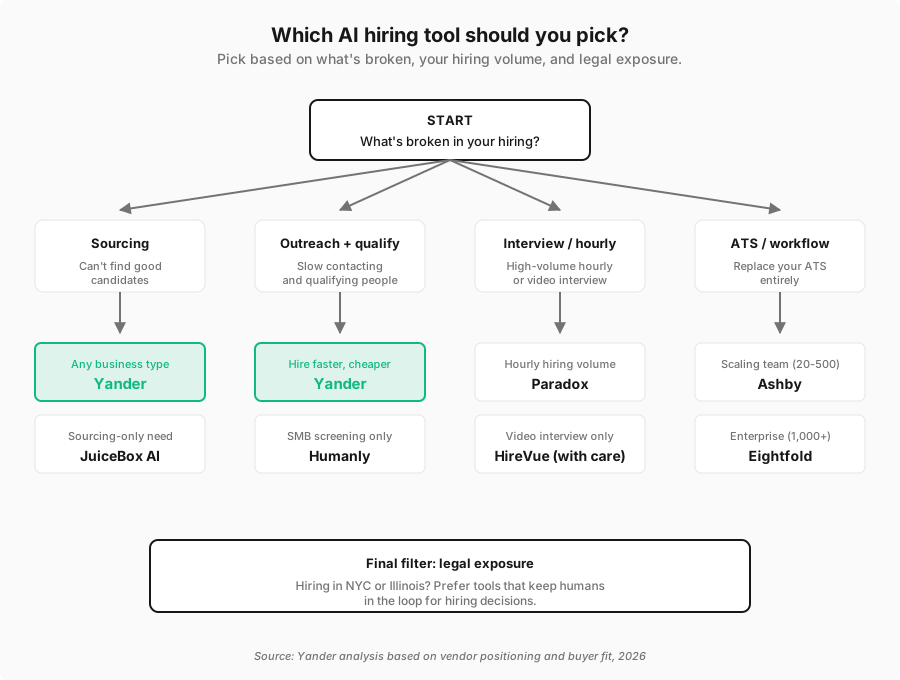
Question 1: What stage of hiring is broken?
If sourcing is broken: Yander, JuiceBox, or Fetcher.
If outreach is broken: Yander or Fetcher.
If qualification is broken: Yander or Humanly.
If interviewing is broken at high volume: Paradox.
If your ATS is the bottleneck: Ashby.
Question 2: How big is your hiring volume?
1 to 10 hires per year: Humanly or a basic ATS plus DIY GPT prompts. Don't overspend.
10 to 100 hires per year: Yander or Ashby.
100 to 1,000 hires per year: Yander for distributed hiring, Paradox for hourly volume, Ashby for software-company scale-ups.
1,000+ hires per year: Eightfold for talent intelligence, Paradox for hourly volume.
Question 3: What's your legal exposure?
Hiring in NYC or Illinois: use vendors with published bias audits, or use tools (like Yander) that don't make automated decisions in the first place.
Hiring senior knowledge workers: disparate-impact risk is real if you let AI auto-reject. Keep humans in the decision loop.
Hiring hourly at scale: Paradox has the cleanest legal record for that specific use case.
Who should use what
| Team type | First choice | Second choice |
|---|---|---|
| Recruiting agency | Yander | JuiceBox AI |
| Software company (5-50 people) | Yander | Ashby |
| Software company (50-500 people) | Ashby | Yander |
| Brand or other business hiring continuously | Yander | Humanly |
| Enterprise (1,000+ people) | Eightfold | Ashby |
| High-volume hourly | Paradox | Yander |
| Sourcing-heavy operation | Yander | JuiceBox AI |
FAQ
How much do AI hiring tools cost in 2026?
Pricing spans a huge range. The cheapest credible tools start at $79 per user per month (JuiceBox self-serve). Mid-market tools like Yander and Humanly run $200 to $1,500 per user per month. Enterprise tools like Eightfold, Paradox, and HireVue typically start at $30,000 per year and scale into six figures. Most vendors hide pricing behind a sales conversation. Yander publishes ours publicly because hiding pricing is a tell.
What's the difference between Paradox, Eightfold, and Humanly?
Three different products despite overlapping marketing. Paradox is conversational AI for high-volume hourly hiring (think QSR, retail, healthcare). Eightfold is enterprise talent intelligence with deep internal mobility features for 1,000+ person companies. Humanly is a chatbot focused on AI screening and scheduling for small and mid-size teams. Don't pick between them based on the AI label. Pick based on whether you're doing hourly volume, enterprise talent strategy, or small-team screening.
Are there any free AI hiring tools worth using?
A few. Loxo has a free tier that includes AI sourcing for small teams. Manatal offers a 14-day free trial that gives you a real test of their product. For DIY, you can build a functional resume screener with GPT-4 and a structured prompt for about $0.30 per resume. The quality is fine for filtering obvious mismatches. It won't replace a real tool for the final decisions but it's a useful first-pass filter while you evaluate paid options.
What are the best alternatives to HireVue?
If you specifically need AI video interview, alternatives include Sapia, Karat, and HireFlix. If you're using HireVue for general AI screening and you'd prefer something with less legal baggage, Yander covers the same goal differently: source and qualify candidates instantly, keep humans in the decision loop, avoid the disparate-impact exposure HireVue is dealing with.
Do I need an AI hiring tool if I'm already using an ATS?
It depends on your bottleneck. If you're spending more than 5 hours a week trying to find good candidates or 10 hours a week reaching out and qualifying them, an AI sourcing and qualification tool like Yander will pay for itself fast. It sits alongside your existing ATS, you don't have to rip and replace. If your ATS itself feels broken in ways your team complains about constantly, that's when you consider a full replacement with Ashby.
The honest takeaway: there is no universal best AI hiring tool. There's a best tool for your hiring volume, the stage of your process that's broken, and your legal exposure. Yander is the one I work on and the one I recommend first because of what it does: instantly source the candidates you'd miss, reach out on your behalf, qualify them, and let you make the actual hiring call. For other use cases, the seven tools above are each better at something specific.
If you're not sure where to start, the decision matrix above is the shortest path to the right answer.
Written by
Yander Team
Employee Engagement Experts
The Yander team helps remote leaders understand and improve team engagement through data-driven insights. We believe in privacy-first approaches that support both managers and employees.