I've spent the last year evaluating AI recruiting tools for agency owners and startup founders who ask me the same question: "Which one should I actually use?" And every time I go looking for a good comparison, I find the same listicle recycled by 15 different sites, all of them suspiciously kind to every tool they review.
So here's my honest take. I've looked at what each tool actually does well, where it falls short, and what the review sites won't tell you. Including the lawsuits.
A quick note on what "AI recruiting" means right now
The term gets slapped on everything from a resume keyword matcher to a fully autonomous hiring agent. These are not the same thing and it matters which one you're buying.
There are roughly three categories:
Tools that bolted AI onto an existing ATS. Greenhouse and Workable both did this. The core product is the applicant tracking system. AI generates job descriptions, suggests interview questions, scores candidates. It makes the ATS better but the ATS is still the product.
AI-native platforms where AI is the product. Paradox, Humanly, and Yander fall here. The AI isn't a feature. It's the thing doing the work. Screening, scheduling, communicating with candidates, sometimes even conducting interviews.
Sourcing-first tools that use AI to find people. Gem and Fetcher focus on discovering and matching candidates rather than processing applications. They're less about screening and more about building pipelines.
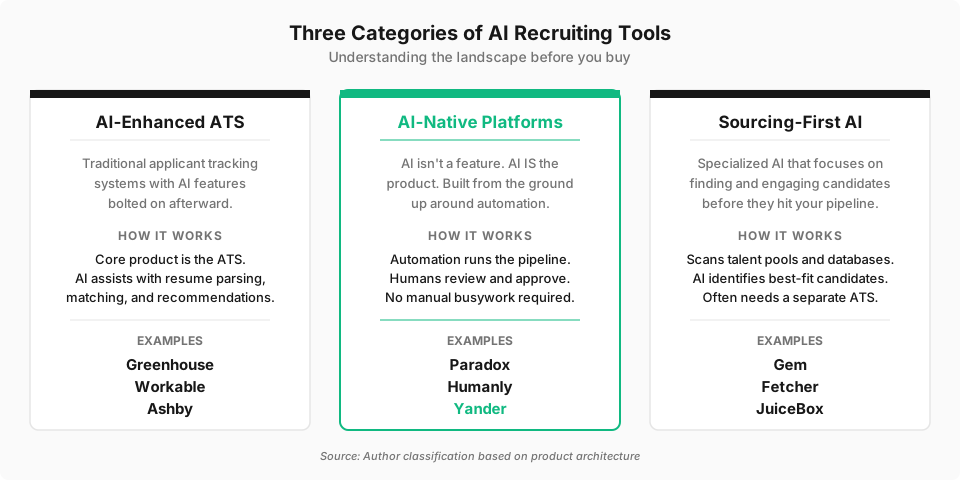
Knowing which category you need saves you from buying the wrong thing. An agency owner managing 10 client pipelines needs something different from a VP of Engineering who wants better candidate matching.
The tools worth looking at
1. Yander
Best for: remote teams, agencies, and startups that want to automate the entire hiring pipeline.
I built Yander to solve the problem I kept seeing with all of these tools: they automate parts of hiring but still leave you doing most of the work. Yander generates the job description, posts to multiple platforms, screens candidates against a weighted scorecard, runs skills assessments, and schedules interviews. The hiring manager's only required involvement is showing up to the interview.
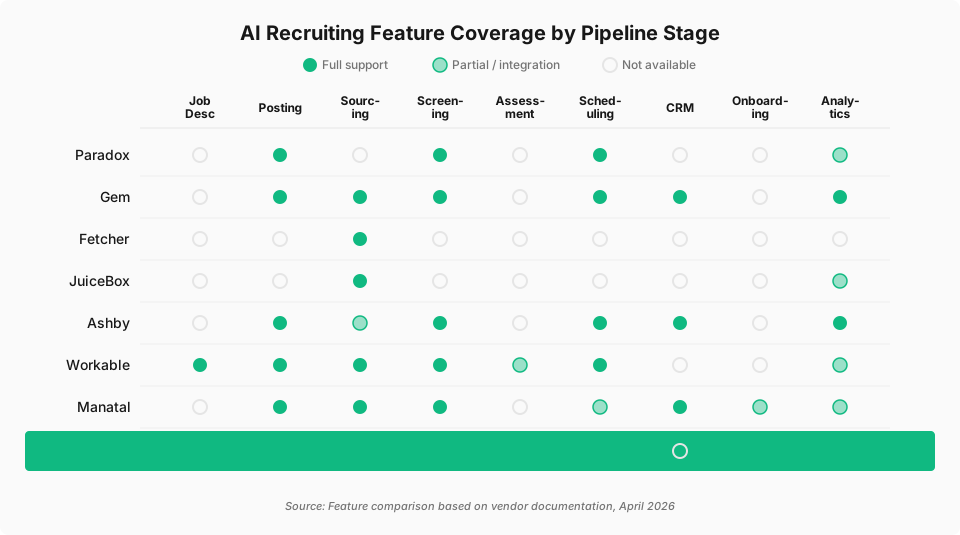
It handles sourcing, screening, assessments, scheduling, and onboarding in one platform. Most tools in this list do one or two of those well. Yander does the full pipeline. It's built for teams that want to hire remotely without stitching together five different tools or building a recruiting department.
2. Paradox (Olivia)
Best for: high-volume enterprise hiring. Retail, restaurants, logistics, healthcare.
Paradox built Olivia, a conversational AI that handles screening, scheduling, and candidate communication via chat, SMS, and voice in 100+ languages. Chipotle cut their time-to-hire from 12 days to 4 using it. GM saved $2 million in recruiter time within the first six months of implementation. Over 1,000 clients globally.
The pitch is that Olivia replaces the front-end recruiting work entirely. Candidates interact with the AI. Recruiters only get involved when a human is actually needed.
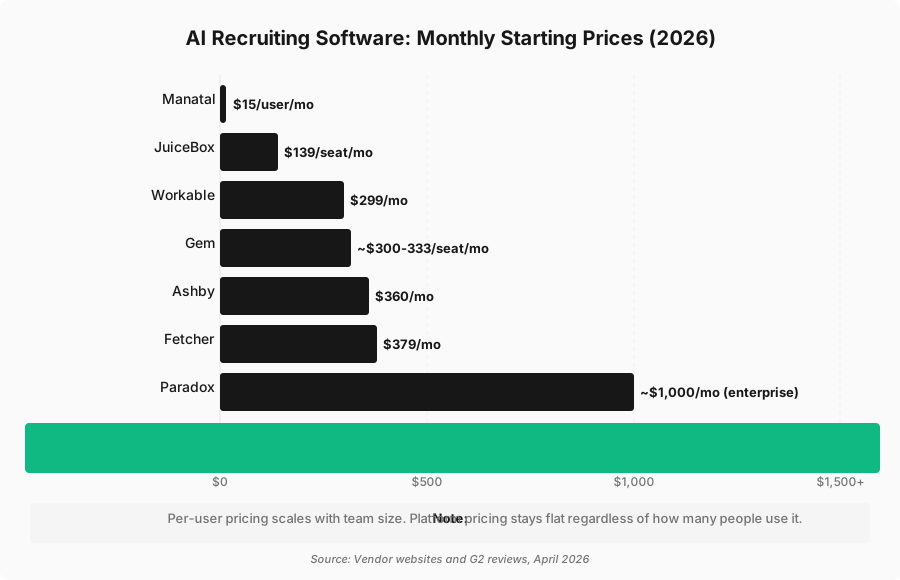
The honest downside: analytics are weak, customization is limited (users report they can't easily modify interview questions or scheduling flows), and pricing is enterprise-only with no transparency. Expect to start around $1,000/month and go up from there. If you're not hiring at serious volume, this is overkill.
G2: 4.2/5. Capterra: 4.4/5.
3. Gem
Best for: mid-market to enterprise teams replacing a stack of recruiting tools with one platform.
Gem is an AI-first all-in-one that combines ATS, CRM, sourcing, scheduling, and analytics. Their claim is that AI is embedded in every workflow rather than added on top. Recruiters report significant productivity gains according to Gem's own data. The AI personalizes outreach messages and Gem reports 30 to 40% higher positive response rates compared to generic templates.
Used by 1,200+ companies. Cuts recruiting tool costs 30 to 50% by consolidating everything.
The honest downside: expensive. Most frequently cited complaint on G2. Pricing runs around $3,600 to $4,000 per seat per year. LinkedIn integration doesn't always pull contact data reliably. Reporting dashboard has bugs and limited customization. No live support. Steep learning curve.
G2: 4.8/5.
4. Ashby
Best for: data-obsessed recruiting teams at scaling companies.
Ashby is an all-in-one ATS, CRM, scheduling, and analytics platform that ships weekly product updates. Their analytics are genuinely best-in-class for this category. AI handles outreach personalization and interview feedback summaries. Rated 4.7/5 on G2.
The honest downside: steep learning curve. The scheduling section alone has 14 settings tabs. English-only. No Boolean search, which frustrates experienced sourcers. AI credits and advanced analytics cost extra. Starting price around $360/month makes it the most expensive base-tier ATS on the market.
5. Workable
Best for: SMBs that want one platform covering everything at a reasonable price.
Workable has been recognized by Forbes Advisor as a top AI recruiting platform. AI features include candidate screening and scoring, salary estimation for US and UK roles, AI job descriptions with tone control, and passive candidate sourcing. The AI Screening Assistant summarizes candidate-job fit, which saves time on initial reviews.
Pricing is transparent: $299/month Standard, $599/month Premier, $1,200+ Enterprise.
The honest downside: reporting and analytics are limited compared to Ashby or Gem. Customer support quality is inconsistent. Add-on fees for video, texting, and assessments erode the price advantage. Can't geo-filter applicants.
6. Manatal
Best for: agencies and SMBs that want AI recruiting on a budget.
Manatal is the cheapest credible option in this space at $15/user/month. AI candidate scoring, social media profile enrichment from 20+ platforms, CRM for agency client management, 2,500+ job board integrations. Used by 10,000+ teams in 135+ countries.
The honest downside: reporting is the most common complaint. API access is locked behind the $55/user/month tier. Job postings take up to 48 hours to go live on some boards. For a full review, I wrote a detailed Yander vs Manatal comparison.
7. Fetcher
Best for: SMBs that need passive candidate sourcing without building a sourcing team.
Fetcher combines AI candidate discovery from a 500 million+ profile database with a human recruiting team that vets candidates alongside the AI. This hybrid model is what differentiates it from pure AI tools. The humans catch what the AI misses.
Pricing is public and reasonable: $379/month on annual billing for the Growth plan, $649/month for Amplify.
The honest downside: AI matching is imprecise for niche or technical roles. It's sourcing only. There's no ATS, no screening, no analytics. Email deliverability issues are frequently reported. Platform stability could be better. Annual contracts with no flexibility if your hiring needs change.
8. JuiceBox (PeopleGPT)
Best for: recruiters who want AI-powered candidate sourcing with natural language search.
JuiceBox’s PeopleGPT lets you search 800 million+ profiles across 30+ data sources by typing what you’re looking for in plain English. No Boolean strings required. It pulls from LinkedIn, GitHub, Stack Overflow, personal websites, and research papers. Backed by Sequoia Capital with $36 million+ in funding. Used by 3,000+ companies including Ramp, Perplexity, and OpenAI. Their autonomous Juicebox Agents run 24/7 sourcing in the background and learn from your feedback.
Pricing starts at $139/seat/month for Starter, $199/seat/month for Growth. Autonomous agents are an additional $199/agent/month.
The honest downside: it’s a sourcing tool, not a recruiting platform. No ATS, no scheduling, no assessments. Email-only outreach with no LinkedIn InMail or multi-channel options. ATS integrations are locked to the custom-priced Business plan. The 800 million profile database sounds impressive but recruiters report high email bounce rates from stale data. The AI works best for tech roles and struggles with niche or non-technical positions. Multiple users have reported LinkedIn account suspensions after using the Chrome extension. For a company with $80 million+ in funding, the near-absence of G2 and Capterra reviews is notable.
The thing nobody else will say
If you're buying AI recruiting software in 2026, your due diligence should include asking the vendor about their bias audit results, their data handling practices, and whether they've been named in any regulatory complaints. Several prominent tools in this space have active legal cases around bias and data handling. These are not theoretical risks anymore.
How to actually choose
Don't start with features. Start with your situation.
Hiring 500+ people a year in similar roles? Paradox or Humanly. Volume is their game.
Scaling tech company with 10+ open roles? Gem or Ashby. You need the ATS + analytics depth.
Agency managing hiring for clients? Manatal for budget, Yander for automation.
Startup with no recruiting team? Workable or Yander. One gives you a solid ATS with AI features. The other automates the pipeline so you don't need a recruiter.
Enterprise with 10,000+ employees? Greenhouse for structured hiring with AI layered on.
Need to source passive candidates? Fetcher for budget-friendly hybrid sourcing. JuiceBox for AI-powered natural language search. Gem for integrated sourcing + ATS.
FAQ
Which AI recruiting tool is the cheapest?
Manatal at $15/user/month. But cheap and right are different things. If you're an agency, Manatal's CRM makes it worth the price. If you need pipeline automation, the per-user pricing scales badly and you'd be better with a platform-priced tool.
Are these tools compliant with AI hiring laws?
It depends on the tool and the jurisdiction. NYC, California, Illinois, and Colorado all have specific AI hiring regulations. Ask every vendor: do you conduct annual bias audits? Can you provide audit results? Do you offer candidate notification features? Some tools like Paradox have compliance features built in. Others leave it to you.
Can AI replace human recruiters?
For parts of the job, yes. Screening, scheduling, initial outreach, and pre-qualification can all be automated. The parts that still need humans: selling candidates on the opportunity, negotiating compensation, making final hiring decisions, and building relationships. The best tools automate the repetitive work so recruiters can focus on the human work.
What about ChatGPT for recruiting?
People do search for "ChatGPT for recruiting" and the answer is: it's a general purpose tool being used for recruiting tasks, not a recruiting tool. People use it to write job descriptions, draft outreach messages, and prep interview questions. It works for those tasks. But it doesn't connect to your ATS, screen candidates, schedule interviews, or track your pipeline. Purpose-built tools do.
How do I evaluate AI bias in these tools?
Ask for the tool's bias audit results. NYC Local Law 144 requires annual independent bias audits for AI hiring tools used in the city. Even if you're not in NYC, the audit report tells you whether the vendor takes this seriously. If they can't produce one, that's a red flag. Also check litigation history.
Written by
Yander Team
Employee Engagement Experts
The Yander team helps remote leaders understand and improve team engagement through data-driven insights. We believe in privacy-first approaches that support both managers and employees.